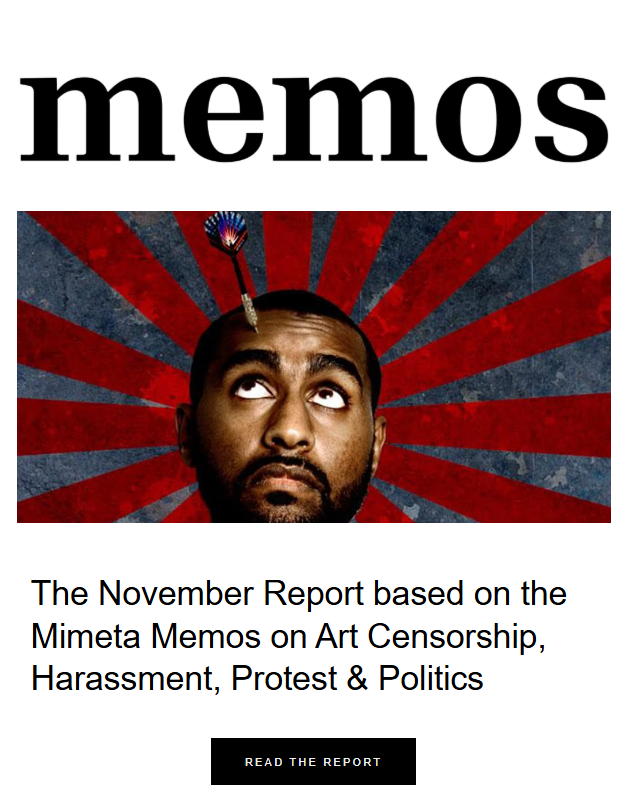
This article analyses patterns of artistic censorship documented by Mimeta in December 2025, focusing on 22 cases primarily from the MENA region. It maps how state security, religious authority, legal systems, informal pressure, and institutional governance converge to suppress cultural expression. The findings show morality and national security as dominant justifications, the rise of unwritten bans and procedural obstruction, and a troubling spread of similar mechanisms into democratic contexts.
Mimeta memos of december 2025 document cases of art censorship, harassment, protest, and political pressure affecting cultural expression, with a strong focus on the MENA region. Drawing on around forty cases, the memos track theatre raids, performance bans, legal battles, and coordinated ideological campaigns targeting artists and institutions. Together, these incidents reveal how state authorities, religious actors, unions, and political movements restrict artistic freedom, often without formal censorship, shaping contemporary cultural life
Posted
Based on the 18 cases published as Mimeta Memos in November 2025, this analysis identifies key patterns in how artistic freedom is being suppressed globally, who is responsible, what triggers these incidents, and what forms censorship takes.
As a whole, the portfolio’s partners’ total budgets have decreased from 9.6 million USD to 7.8 million USD in 2023, with budgets projected to decrease even further going forward.
The 2030 Sustainable Development Goals (SDGs) are crucial to Mimeta’s vision and approach to the idea of cultural development and artistic freedom. They are precisely emphasising how Mimeta can promote democratisation and the implementation of human rights. The SDGs also influence the structures of monitoring and evaluating within programmes of Mimeta.
Stand for Art’ focuses on supporting artists at risk in various ways. The support is tailored to the specific circumstances of the artist and as far as possible allows the artist at risk to remain in the region.
Mimeta’s Theory of Change is built on the fundamental belief that working with and supporting local partners ensures local ownership and the longevity of the intervention. This is also a matter of sustainability, believing that the capacity building of partners and in turn their beneficiaries have value on its own and strengthens the sector even without Mimeta’s continued support.
Mimeta particularly seeks to improve the state of artistic freedom and artistic rights in developing countries. This means that Mimeta’s targets for intervention are potential partners who are and will be concerned with promoting artistic freedom in countries eligible for Official Development Assistance (ODA)
Posted
One of the strategic discourses given much attention by our partners relates to this significant role of the arts and storytellers, in shaping our understanding of the world around us. In contemporary terminology this understanding is defined as the narratives we relate to. For our partners the possible shaping of changes in these narratives is a primary motivation for their work, according to a survey Mimeta did among partners in 2022.
The respondents in Mimetas 2022 survey are strong in proclaiming that their work contributes to the protection of artists and storytellers, and there is a very strong understanding of the relevance of human rights for the arts communities in the countries where our partners are active.
Access to cultural an artistic expression as a human right, has also been at the core of the mission of MIMETA’s long term partner, Action for Hope (AfH). Founded in 2015 to the backdrop of the crack down on the Arab Spring in the MENA region, AfH had a vision of a just and tolerant world, where communities risking social fragmentation because of war, displacement, and extreme poverty are empowered to claim their right to artistic expression and access to culture
An organizational matter high on the agenda is the ways of outreaching. This was actualized during the epidemic period, as it called for new digital solutions, and again actualized with focus on societal impact. Most of the organizations are still developing these digital facilities to improve dissemination and outreach and the use of rich media in their communication.
Mimeta has a zero-tolerance policy regarding corruption and has established clear and rigorous policies and mechanisms which ensure that corruption does not take place at any level.
Ettijahat actively uses gender as a lens in their operations and consults with a gender expert in the design of their activities. This was noted in its work. Artists working with unconventional art forms are encouraged to apply, as are refugees and members of the LGBTQIA+ community, and especially women in these groups
The aspect of narratives and who is presenting them goes to the heart of inclusion and is integral to Mimeta’s work. In the past, and 2023, Mimeta and partners have focused on telling the story of underprivileged groups, such as refugees. Partners organisations such as Ettijahat and L'Art Rue have an emphasised focus on the issue of inclusion of marginalised communities, including projects focused on telling the story of refugees, minorities, women and members of the LGBTQIA+ community, as well as people with disabilities.
Many of the initiatives of Mimeta’s partners have the opportunity to engage the public in questions of climate justice and environmental consciousness
The 9th edition of the Dream City festival, held from September 22nd to October 8th, 2023, delivered more than 130 presentations of 43 different artworks, 13 of which are new creations. Out of the 43 artworks included in the festival program, 13 were new creations developed by Tunisian, Arab, and international artists as part of L’Art Rue’s artistic residency program.
The 2023-2024 edition of ‘Research’ selected 20 researchers (14 female and 7 male) from the Arab region who are currently conducting research contributions to creative projects and art productions in the Syrian and Lebanese contexts. 19 of these researchers will have their work published in 2024.
The “Life” program of Ettijahat supports Syrian cultural entities. The organisations targeted by the Life Initiative and their beneficiaries play a vital role in the Syrian arts and culture sector and contribute to the establishment of a diverse, inclusive, and robust civil society both in the region and in the diaspora.
The essence of Sanad, Ettijahat’s legal support programme, is the improvement of the artistic sector’s position on rights issues, helping art practitioners to understand their rights and how to solve legal issues related to their situation and artistic productions.